


We believe that the success of building long-term relationships with our customers depends not only on providing the right product at the right price, but also on continuously improving reliability. Our vision is to be a global healthcare company that is customer-focused and committed to excellence.
Our manufacturing factory is equipped with advanced heat sealing machines, sewing machines, cutting machines, cast film production lines, laminating machines, mask machines and other equipment. They have passed international certifications (ISO, CE, FDA, etc.) and are frequently subject to internal and third-party inspections.
Our products use high-quality materials and manufacturing processes to provide you with protection you can trust. We have established a strict quality control system in accordance with ISO 13485 and FDA related standards to ensure that all our products meet and exceed high quality standards.
Our products include non-woven protective equipment, disposable masks, disposable isolation gowns, disposable hats, disposable shoe covers, disposable boot covers, etc. They are widely used in medical, dental, industrial, laboratory, health and beauty markets.
Our company is committed to building customer partnerships through strong relationships, providing high value, quality products and exceptional service through continuous process improvement. In addition, our products have been sold to more than 40 countries around the world and enjoy a good reputation in domestic and foreign markets.
-
![일회용 KN95 페이스 마스크]() 일회용 KN95 페이스 마스크
일회용 KN95 페이스 마스크Kn95 안면 마스크는 중국 표준 마스크로 중국에서 입자 여과 효율이 있는 일종의 마스크입니다. Kn95 마스크와 N95 마스크는 사실 입자 여과 효율이 동일합니다.
-
![일회용 Suigical 얼굴 마스크]() 일회용 Suigical 얼굴 마스크
일회용 Suigical 얼굴 마스크외과 용 마스크는 착용자의 입과 코 사이에 물리적 장벽을 만들고 즉각적인 환경에서 잠재적 인 오염 물질을 만드는 느슨한 일회용 장치입니다.
-
![일회용 FFP2 안면 마스크]() 일회용 FFP2 안면 마스크
일회용 FFP2 안면 마스크고효율 의료 등급인 FFP2 마스크. 한편, 영국과 미국에서는 FFP2 덮개가 덜 일반적입니다.


When air quality is poor due to pollutants, wearing a mask can protect your respiratory system and overall health. Masks can help you isolate many polluting gases and powders, such as gases from motor vehicles and industrial processes (carbon monoxide, nitrogen dioxide, and sulfur dioxide), ground-level ozone, particle pollution, etc.
01
Especially if you have pollen allergies, wearing a mask could decrease allergen exposure.5 A mask that covers your mask and nose can help filter out pollen or irritants. Masks also change the moisture and temperature level of the air you breathe in, further reducing allergy symptoms.
02
03
04
05


|
17.5cm*9.5cm |
|
|
Level 1 ,level 2 or level 3 |
|
|
Case size: 52cm*38*30cm |
|
|
Non-woven +melt-blown + non-woven layers. |
|
|
25+25+25g |
|
|
17.5cm*9.5cm |

*Cover your Mouth, Nose and Chin with the Mask: Only covering your mouth with a face mask does not completely protect you from spreading or becoming infected with COVID-19, because droplets infected with the virus can settle in your mouth and nose.
*When Removing Your Face Mask, Repeat Steps 1 and 2: You wear your mask to protect yourself from harmful germs. Not taking proper precaution when removing your face mask could actually undo all that work that your mask did for you.
Level 1 Disposable Face Masks
Level 1 face masks provide low barrier protection and are for general use. While they do have good filtration properties for a face mask, unlike the level 2 respirators, they do not fit as tightly and securely. Level 1 face masks are normally for standard medical procedures and low-fluid cases. While they are cost-effective options, these masks can only resist 80 mm Hg to penetration by synthetic blood. In comparison to level 3 face masks which provide 160 mm Hg resistance.This means that in terms of liquid particles and filtration, level 3 face masks and even level 2 respiratory masks are better options for use in work environments and medical environments.
Level 2 Disposable Face Masks
Typically, level 2 face masks come in ratings that identify their effectiveness to filter out harmful particles. The disposable P2 and N95 face masks/respirators can filter extremely fine particles from the air to minimise exposure to smoke, poor air quality and respiratory diseases. A P2 Disposable Respirator is an example of a level 2 facemask. FFP2 Disposable Respirators are ideal for working environments in which harmful particles can be found in the breathing air in industries like cleaning, maintenance, construction or for medical professionals to protect themselves against liquid particles, fog, dust, and smoke, bacteria and aerosols.
Level 3 Disposable Face Masks
Level 3 disposable mask is very suitable for protection in environments with high risk of liquid exposure (splash or spray) to provide protection. The ASTM level 3 surgical mask includes 4 layers of structures, which can provide clinicians with the comfort, protection and breathability they seek. They are designed for fluid protection. The mask has adjustable nose and soft ear hanging, which is convenient to wear and increase comfort.
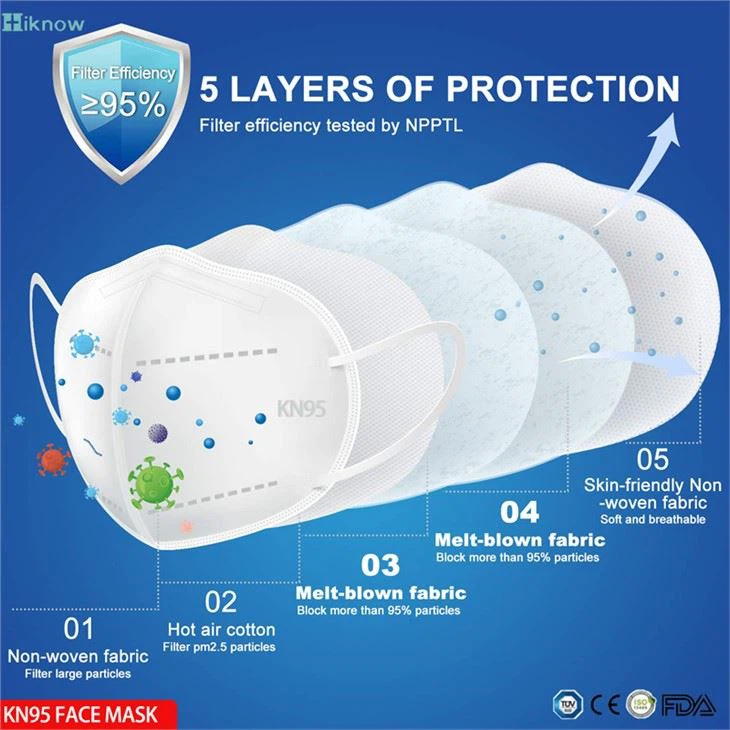
In disposable face masks, medical masks, and KN95/N95 masks, the nonwoven spunbond polypropylene materials are ideal for the outer and inner layers of the mask.The nonwoven spunbond polypropylene is a breathable material. This allows for splash resistance on the outer layer. It is useful as the inner layer because it is absorbent and whisks moisture away from the face.
The middle layer between the two pieces of nonwoven spunbond polypropylene is made of a nonwoven meltblown fabric. The meltblown fabric in mask production acts as the filtration mechanism between the layers of nonwoven spun-bonded polypropylene that helps to prevent the spread of germs. In addition to that, it supplies shielding, oil absorption, and heat insulation. It is ideal for filtering air and liquid particles making it a good raw material to incorporate into mask making. Masks without a filtration system cannot help to protect the mask wearer from the potential risk of infection. In some versions of the medical mask on the market, you may find that they incorporate a double-layered meltblown fabric for more support and protection. This is seen in the KN95 that has a 5-ply make-up where more protection is necessary.
We understand that all of these face masks are the same size while everyone has a different face and/or head shape, so some features help to adjust it to a customized fit via the elastic ear loop and the wire nose bridge. The elastic ear loop is made out of nylon and spandex material. It is a little roped strand that has enough give to make it a one-size-fits-all face mask. The nose wire bridge helps to create an adjustable fit by clamping around the nose as needed to hold it in place.
Type I masks have a BFE of 95%, filtering larger respiratory droplets during exhalation. Type I face masks can be used by people and patients to reduce the risk of spreading an infection to others. They are appropriate for use in all public areas and places where social distancing should be respected.
Type II masks have a BFE of 98%, filtering larger respiratory droplets during exhalation. Type II face masks are appropriate for use in all areas where Type I face masks can be used while offering a higher level of protection. Along with Type IIR face masks, these are designed for use in hospital, medical, and care settings.
Type IIR masks have a BFE of 98%, filtering larger respiratory droplets during exhalation, with a splash-resistant layer to protect from coughs and sneezes. They are appropriate for use everywhere Type I and II face masks are used, as well as close proximity environments such as hospitals, doctor's surgeries, dental clinics, and care homes.
FFP1 Respirator Masks
FFP1 masks offer the minimum level of protection from this mask type, with 80% filtering efficiency. These masks are most commonly used to protect the wearer from breathing in solid dust particles like sand and sawdust when doing DIY activities. They are not effective at protecting against toxic substances, pollen, or infectious particles and bacteria.
FFP2 Respirator Masks
FFP2 masks provide 94% filtering efficiency, this is the minimum requirement as stated by the WHO from protection during the Covid-19 pandemic. They offer the same level of protection as the N95 mask that is used in the US. FFP2 masks do not have valves, which means their filtration system is built into the layers of the mask through which you breathe.
FFP3 Respirator Masks
FFP3 masks provide filtering efficiency of 99% and are recommended by the NHS for use in high-risk areas such as hospitals. FFP3 masks offer the highest level of protection against droplets and aerosols when worn correctly, they provide a substantially better level of protection than FFP1 and FFP2 masks, defending against solid and liquid aerosols.


Q: Can face masks and barrier face coverings be cleaned and reused during COVID-19?
Q: Are surgical masks the same as N95 masks?
Q: What are EN-149: 2001 masks?
Q: Can KF94 masks be used to protect against Haze?
Q: Is the N95 face mask an adequate protection against haze? Does it protect against PM2.5?


